

Eject Motor Gearbox Autopsy

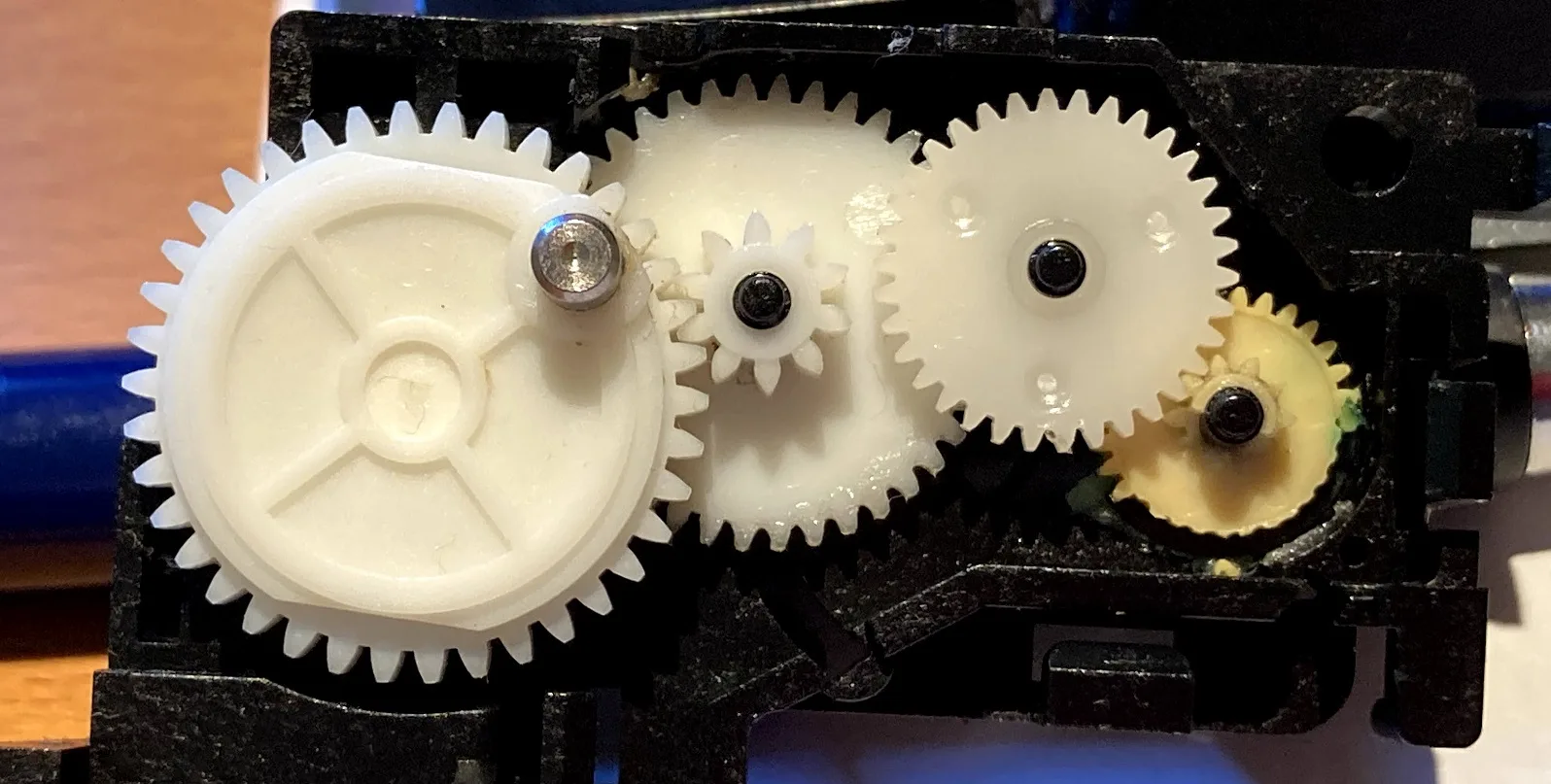
I disassembled the dead external floppy drive that I described in my previous post, and extracted the auto-inject SuperDrive mechanism that was inside. After carefully removing and opening the eject motor assembly, I discovered a gearbox with four plastic gears. And just as I’d suspected, one of the gears was completely trashed, with half the teeth missing. You can see the damage to the right-most gear in the photo. So now when the eject motor turns on, it can’t actually turn the gears to reach the desired position, and the motor spins forever. That’s the source of the continuous high-pitched whirring sound I noticed after the drive died.
I’m not sure why this happened. The miswiring problem that I described earlier would have made the eject motor run continuous eject and insert cycles, which isn’t good, but shouldn’t have destroyed the gearbox. Maybe these 30-year-old plastic gears were already brittle, and it’s just a coincidence that one broke when it did. Or maybe the continuous eject and insert cycles caused the gears to get hot, and the heat caused one to break.
With the eject motor assembly removed, inserting and ejecting disks manually, the drive can read disks OK. That’s a small consolation.
To continue testing, I’ll need to hunt down another auto-inject SuperDrive in working condition. I’ll also need some black- and red-label 800K drive mechanisms, since the red-label 800K that I found earlier also has a broken eject mechanism. Just my luck! For that drive, it looks like it’s a broken eject motor rather than a broken gearbox. It would be great if I could somehow make a working eject motor assembly out of the parts from two different broken assemblies, but unfortunately their gearboxes are different and not interchangeable.
Not sure if these will fix any of your drives, but FYI, they exist: https://www.shapeways.com/product/27DNUVPJA/replacement-floppy-drive-gear-for-macintosh (source files also available on thingiverse.)
And yes, it is common for eject gears to break at this age. Been a problem for 800k drives for some time.
Thanks, maybe I’ll give that replacement gear a try. For the moment I was able to liberate another auto-inject SuperDrive from an old Macintosh IIsi.
After a closer look, both of the drives that I mentioned seem to have identical broken gears, so I’ll try the replacement gear.
Something I found searching the web. May or May not work. 7.50 for twelve. Hopefully this helps
https://www.google.com/amp/s/amp.reddit.com/r/VintageApple/comments/f5w03m/free_macintosh_floppy_drive_eject_gear_3d_model/
These are the parts I use and are excellent for my drives.
https://www.ebay.co.uk/itm/333463751453
Shopping for replacement gears led me to browse ebay’s vintage computer offerings for the first time in a few years, and wow the prices for equipment have jumped much higher. $200 dollars for ugly broken non-working systems, $500-1000+ for working systems in decent shape? It seems a little crazy, but I suppose this hobby is getting more popular and the available supply of working classic computers is ever-shrinking.
Prices were inflated before the pandemic. They have only gotten worse. A lot of it doesn’t make sense, must be quite a bit of “funny money” out there.
Hi. I bought some replacement gears from seller retro_shopbox on eBay – I believe he is in Australia. They are still available, and you get three of them!
Apple Macintosh 800K 1.44MB Replacement Floppy Drive Eject Gear MFD-75W MFD-51W
https://www.ebay.com/itm/223654181497?hash=item3412d3fa79:g:0hwAAOSw5ZVdc0Av
PS. The seller also includes clear instructions.
Those gears occasionally broke even back in the day. I replaced a few of them back in the 1980s. No eBay back then of course, but they were available through mail order parts places or at fairly high prices sometimes from computer dealers if they would sell parts. As others have noted, 25+ year old gears are often brittle from age and break.
The 3D printed replacement gears from Shapeways worked great. Thanks for the tip! I was able to repair the auto-inject Superdrive mechanism that was mentioned in “Death of an M0131 Floppy Drive”, as well as another red-label 800K drive mechanism.
Happy to hear my gears worked out. If you have any problems feel free to contact me!
Yep, this is a common issue. I’ve had to repair both 1.44M SuperDrives in my Macintosh LC because they failed this way, one being original, and the other one I bought refurbished. That one darned gear seems to like to give out and render ejection impossible, and there’s no warning as to if or when it’s going to fail.