

Mac ROM-inator II
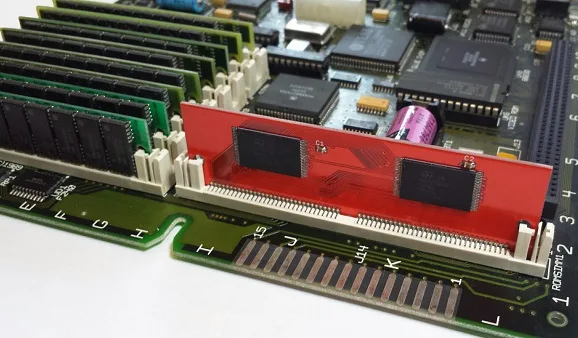
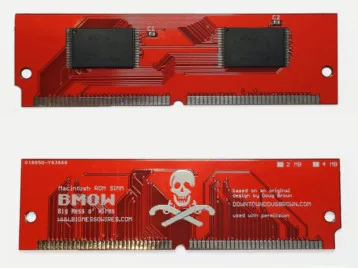
Want to add new features to your old Mac? The Mac ROM-inator II replaces the stock Macintosh ROM SIMM with a 4 MB custom flash memory module. Add a bootable ROM disk, make your system 32-bit clean, gain HD20 hard disk support, and more. The Mac ROM-inator II supports the Macintosh SE/30, IIx, IIcx, IIci, IIfx, and IIsi.
The Mac ROM-inator II is great for breathing new life into your old SE/30 or II-series Macintosh. The ROM disk provides fast and convenient boot-ups and a collection of utility programs, games, and customized startup sounds and icons add a touch of fun. The ROM SIMM comes pre-programmed with a BMOW-made custom ROM containing the following changes:
- ROM disk provides a diskless booting option
- HD20 hard disk support built-in
- 32-bit clean – allows use of System 7.6+ and more than 8MB RAM
- Memory test is disabled for faster booting on 16MB+ systems
- Customized startup chime – major 9th arpeggio
- Happy Mac icon is replaced by a color smiling “pirate” Mac
- New startup menu screen displays installed RAM, addressing mode, and ROM disk details
The ROM-inator II is based on Doug Brown’s earlier Mac ROM SIMM design, used with permission.
Downloads
ROM-inator II instruction manual: PDF
BMOW ROM SIMM Programmer 3D-printable case: simm programmer case
BMOW ROM SIMM Programmer 3D-printable case: simm programmer case
The ROM SIMM and pre-programmed ROM contents are compatible with the Macintosh SE/30, IIx, IIcx, IIci, IIfx, and IIsi. The SIMM simply snaps into the ROM socket on the computer’s logic board. Note the Macintosh SE differs from the SE/30 internally, and is not compatible with the ROM-inator II.
CPU accelerators such as the Daystar PowerCache and Turbo series are not compatible with the ROM-inator II.
Some SE/30 hardware may require a shim to ensure ideal fit of the SIMM – see instructions for details.
If running Mac OS System 7.5 or later, some Mac models require a software patch to the System file.
Benefits
HD20 Hard Disk Support – The pre-programmed ROM includes support for HD20-type hard disks, such as the hard disk emulation mode of the BMOW Floppy Emu disk emulator. The stock ROMs in the Macintosh SE/30, IIx, IIcx, and IIfx lack HD20 support, so these computers are normally unable to use HD20 disks. With the ROM-inator II, HD20 support is built-in.
32-Bit Clean – The pre-programmed ROM also makes the Mac 32-bit clean, enabling it to use more than 8 MB of RAM natively without the need for special system enablers or extensions, and to run newer versions of System software that require 32-bit clean ROMs. Some older Macintosh models like the SE/30, IIx, and IIcx have stock ROMs that are “dirty”, meaning they can’t support 32-bit addressing without ROM patches. Using the Mac ROM-inator II and the pre-programmed ROM, the Mac SE/30 can support up to 128MB of RAM!
Faster Startup – The power-on RAM test is disabled in the pre-programmed ROM. This speeds up boot times on Macs with 16 MB or more of RAM, skipping a time-consuming check that can take up to 1 minute otherwise.
ROM Disk
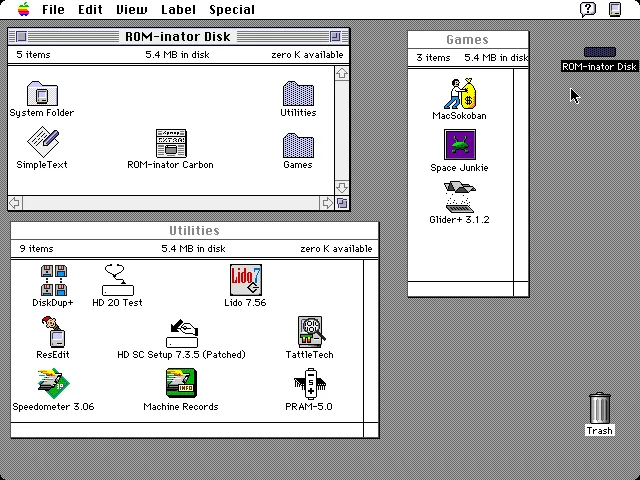
With the ROM-inator II, you have the option to boot normally from a standard startup disk, or to boot from the built-in ROM disk. The included ROM disk is like a recovery partition for your Macintosh, containing System 7.1 and a collection of utility programs and games. With the ROM disk it’s possible to boot a computer with an unformatted or damaged hard disk, and then format or repair it using the utility programs. Or boot a computer with no physical disks at all, to perform troubleshooting and diagnostics.
The ROM disk contents are stored compressed, and are decompressed on the fly as needed, in order to squeeze the largest possible disk image into the available space. This requires 1MB of RAM for caching of decompressed disk sectors, so a minimum of 2MB total system RAM is required. The ROM disk can be mounted as read-only, or as a read-write RAM disk.
The 5.4 MB compressed ROM disk contains:
- System 7.1 with System Update 3.0, Apple CD-ROM Extension 5.3.1, AppleShare and File Sharing Extensions, Networking and Printer Extensions
- After Dark 2.0 screensaver
- HD SC Setup 7.3.5 (patched to support formatting non-Apple hard disks)
- Lido 7.56 (for troubleshooting and formatting SCSI disks)
- SCSI Probe 3.3 (for troubleshooting the SCSI bus)
- TattleTech 2.17 (system diagnostics)
- DiskDup+ (floppy disk duplication tool)
- HD 20 Test (troubleshooting an external HD20 drive)
- PRAM-5.0 (modify or reset Parameter RAM settings)
- Speedometer 3.6 (performance benchmarking tool)
- ResEdit 2.1.3 (programmer’s editor)
- MacsBug 6.2.2 (low-level debug tool)
- MacSokoban
- Space Junkie
- Glider+
Usage
Most of the ROM-inator II’s benefits are automatic: just install the SIMM, and you’ll gain HD20 support, 32-bit cleanliness, and custom sounds and icons. Only the ROM disk requires any user interaction.
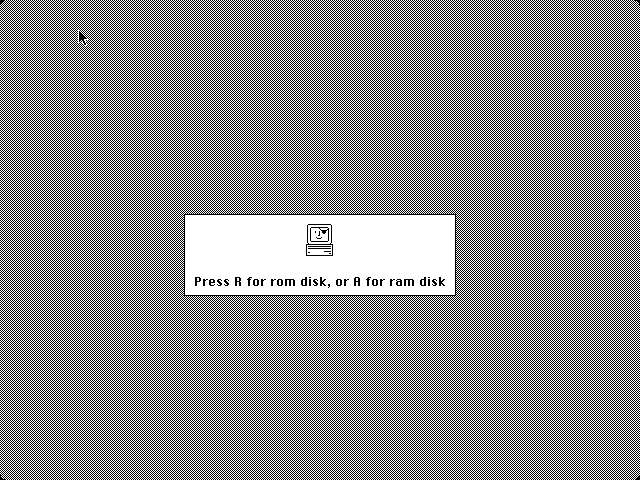
When first powered on, a Macintosh with the ROM-inator II will play a customized startup sound, and display diagnostic info about the amount of installed RAM, the current addressing mode, and the detected ROM disk type. After a moment, an interactive startup menu will be displayed.
To boot from the ROM disk as a read-only disk, press the R key on the keyboard. Or to convert the ROM disk into a writable RAM disk, press the A key. Or to bypass the ROM disk, do nothing and wait five seconds. If no keys are pressed, the Macintosh will boot normally from an attached SCSI or HD20 disk, or wait for a floppy disk to be inserted.
Note: If booting from a SCSI disk when the ROM-inator II is installed, any 32-bit enablers or extensions such as MODE32 or 32-Bit System Enabler must be removed from the disk’s System folder.

Programming
For advanced users with external SIMM programming hardware, the Mac ROM-inator II’s contents can be reprogrammed, providing the ultimate in customization. There’s 4 MB of total flash memory available, of which 3.5 MB is available for any purpose like a new ROM disk image, alternate ROM code, or other crazy experiments. Using compression, this is enough for the base 512K ROM image plus a roughly 5.4 MB disk image. Edit the ROM disk image, change the ROM code, or try other crazy experiments. Go nuts! More information is available on the ROM-inator II Programming Page.
Get One Now
Check out the Mac ROM-inator II at the BMOW Store.
I only have the one configuration, sorry. If you want something closer to stock, you can use a Mac IIsi ROM in an SE/30.
Steve: I am enjoying the ROMinator II and Floppy EMU as a 100Mb Hard Drive and I primarily work with System 6.0.8. I have two problems, that I hope you can assist me with:
I can’t seem to get System 6.0.8 to boot into 32 bit clean mode. Yes, I have removed any Mode32 type INITs, but the ROMinator II opening screen keeps telling me that I am in 24 bit mode. Am I missing something? I tried installing Optima 2.0 and removing all other 3rd party INITs, CDevs, MultiFinder, etc. The ROMinator II opening screen tells me I am in 32 bit mode, but then after the boot process ends, it crashes, telling me that Finder is too old.
Another problem, maybe related to System 6.0.8 is that I see no difference booting into R or A at startup; both give me a nice 7.1 quick startup, but I do not see any RAM disk. I have 68M of functioning RAM installed properly in my SE/30.
Lastly, does ROMinator interfere with my ability to turn on AppleTalk in 6.0.8; which I currently cannot turn on?
I think System 6 doesn’t support 32-bit mode. https://lowendmac.com/2015/32-bit-addressing-on-older-macs/
Pressing “A” doesn’t create a separate RAM disk, but it makes the ROM disk temporarily writable. Please refer to the instruction manual for details.
AppleTalk may try to change a system preferences file when you enable it, in which case it won’t work if you boot from the ROM disk. It should work if you boot from another disk, and should work temporarily if you use the “A” booting option, but will get reset the next time you reboot.
Please use the “customer support” link if you have additional support questions.
It turns out that System 6 does support 32-bit mode, with use of Connectix’ control panel device, Optima 2.0, after its Finder has been easily modified by ResEdit twice to change its version number from 6.1.8 to 6.1.7.
And better yet, ROMinator II is compatible with such use of Optima 2.0 in System 6. Of course all programs and system extension used in this mode must be 32-bit compatible, eliminating the use of MultiFinder and Program Mgr as examples.
Thank you for clarifying the difference between “A” and “R” startup modes. I can indeed now make minor changes in “A” mode, but there is not enough room in the System Folder to add the extensions I would like to add. I will just have to install System 7.x into my use of the Floppy EMU’s HD20 mode for which I created a 100 MB hard drive.
Appletalk is still not working however and I have ordered disk based copies of System 5 and NSI so that I can reinstall it and see if there is still a potential conflict with ROMinator II.
As suggested, I will ask you additional support questions by email.
Thank you for a wonderful product that should be acquired by every Mac SE/30 owner!
System 6 and NSI*
Well, the reinstall of System 6 did not get AppleTalk working, but NSI 1.4.5 got it working like a charm! So ROMinator II is indeed compatible.
My next project is to install System 7.5.3 on the Floppy EMU (with patches), so that using the Farallon iPrint I recently acquired, I can network my Mac SE/30 to my MacMini2,1 with OS X Tiger and leave SneakerNet behind for now.
Is there an image file of the Rominator II’s ROM available? I’d like to use it with BasiliskII or SheepShaver to build disk images for my upgraded SE/30.
The ROM image is available for those who’ve purchased the ROM-inator II, but it’s not a disk image – it’s a replacement system ROM with an integrated bootable ROM disk. I don’t think you could use it with Mac software emulators, or would want to. If you’re looking for a “reference” system disk, Macintosh Garden has a lot of great stuff.
Thanks Steve. I understand, it’s a ROM image, not a disk image. I just mean it would be useful to be able to use it with an emulator when creating disk images for my SE/30, not to try to use the ROM image as a disk image. I have purchased the ROMinator II – two of them, in fact. So how would I go about getting the ROM image?
Sure, I will follow up with you directly. If I understand your question correctly, I don’t think this will do what you’re looking for with the software emulator.
Any chance this may work on a Macintosh LC?
Nope, sorry. Please see the list of supported computer models in the first paragraph.
Macintosh IIvi and IIvx supported? Call me crazy.
Hey Steve! So I just got a DiiMO 50MHz accelerator card for my SE/30… It works great and the DiiMO and ROMinator II play nicely together but I noticed a funny thing that I wondered if anyone else has reported yet. When I boot the Mac with the accelerator installed, the ROMinator’s boot chime is noticeably slowed down. It’s not a big difference and it doesn’t sound distorted but it is affected. I wondered if it has something to do with the computer swapping between the processors right when the ROM plays the chime, but I’m not an expert. It’s not an annoyance and this isn’t a complaint; I thought it was funny and wondered if you were aware. If you’re interested I can send you a video of it. Thanks for making all this awesome stuff! — Dan
Hey Steve! I was under the impression I could use this to boot a computer with system issues. I am likely missing something but is there any documentation on how to restore system 7 with the utility programs. Currently, they don’t open and there are no other apple menu options outside of about this mac. Thanks in advance from a green macintosh newbie!
Yes the ROM-inator II’s built-in ROM disk can boot a computer with a hard drive that’s broken, erased, or missing. It contains a minimal version of System 7 plus some utilities that are helpful for hardware troubleshooting. If you want to install System 7 (full version) on a blank hard disk then you don’t need the ROM-inator. Normally you would boot from Apple’s System 7 installer floppy disks, which will walk you through the steps.
I have a situation with TWO se/30 boards that boot ok with 8MB and display s horizontal bar pattern and fail to boot with larger amounts.
The same happens with the original ROM and with the Rominator — what am I doing wrong?
If you’re seeing strange symptoms even with the original ROM, then it sounds like an SE/30 hardware problem unrelated to the ROM-inator. Check out https://www.reddit.com/r/VintageApple/comments/lh0ue3/macintosh_se30_boot_with_horizontal_lines_any/
Just a note: Rominator 2 in my MacSE/30 works fine with the Diimo 50mhz accellerator card.
I have a new IIfx.
I stuck in 64 MBs of RAM assembled by the 68kmla user hyperneogeo.
I stuck in a Mega and the Mac-ROM-inator II booted up nicely.
I stuck in a SCSI2SD v6 with a 32GB SD card partitioned into 8 volumes (all but 1 are 1.99GBs or smaller).
I installed System 6.0.8 from installers on the SD card and I could boot from the System 6 volume.
I installed System 7.1.2 from installers on the SD card and I was not let boot from the System 7 volume.
Since then I can not boot at all from the SCSI2SD card.
I keep getting the same error message, “This startup disk will not work on this Macintosh model (and so on)”.
I have tried SystemPicker to no avail. I ran Norton Utilities 2.0, also to no avail. The application with the ambulance-icon (the name escapes me now) was used to check the volumes. All OK.
I would be happy to hear if any ideas come to mind.
Thanks
Hi Sean, you can boot from the ROM-inator’s built-in ROM disk, and use the included utility software to reformat your SCSI drive if necessary. It sounds like you may have the wrong System version for your Mac, or some other problem with the System install in the SCSI drive.
Hi Steve,
This is what I shall have to do. I suspect that some of metadata in one of the initial partitions has had false data written to it, probably after I installed System 7.1.2. When I copy across the system folder from the Mega-ROM and boot from that, I get the same message.
Thanks for the reply,
sean.
Hi Steve,
Do you know if it has ever been tested on a Color Classic, assuming someone solder a slot for the ROM? There’s an available position on the board that looks like a ROM slot that was never used.
The ROM-inator II base ROM is a modified Macintosh IIsi ROM, and as far as I know it won’t work in a Color Classic. Same for the IIvi and IIvx, which also have a physically-compatible ROM SIMM slot but are not binary compatible.
Hi,
The new Rominator works to boot my se-30, but will not find my SCSI hard drive. SCSI prob sees something on the bus at ID0 but says no usable drive found. I know your HD SC Setup 7.3.5 is patched for non apple drives, so any clues would be great. The chain is terminated properly so no issue there it appears. Thanks for any help.
Unfortunately I’m not able to offer help for SCSI drive failures. You may have a SCSI chain problem or if it’s an old drive it might simply be dead. For this type of issue I’d recommend joining 68kmla.org or the Vintage Apple Macintosh Enthusiasts group on Facebook. /r/vintagecomputing on Reddit is another good resource.
Hi, question regarding supported hardware. Not so familar with the models.
I would like to insert this solution for a mac se. It has a 20 megabyte hd inside but it is just called mac se. Does this work? Thx
Compatibility: The ROM SIMM and pre-programmed ROM contents are compatible with the Macintosh SE/30, IIx, IIcx, IIci, IIfx, and IIsi. Note the Macintosh SE differs from the SE/30 internally, and is not compatible with the ROM-inator II.
For those of us who are derped out, do you know anyone who sells maxxed out models supported by this ROM?
Also – do you have any upgrades or referral to some for the 128K, 512K, Mac Plus?
My original Mac ROM-inator kit for Mac 128K, 512K, and Plus has been discontinued at BMOW, but Kero’s Mac Mods is one vendor that makes and sells the open-source design: https://en.infinityproducts.co.jp/product-page/rom-inator-resurrections For ROM SIMMs like the Mac ROM-inator II there are several vendors making different designs, but I prefer not to advertise my competition here. You can search for “Mac ROM SIMM” or similar to find some options.
I was excited about this, it seemed all positive, especially having the ROM disk/etc… However, I’m not sure I am enamored with having to patch the system file to get a disk to boot. I hadn’t realized that until I just went to install it and it wouldn’t boot the system on my BlueSCSI. But that is my fault. It is a great product, impressive engineering/etc, but I’m not pondering whether I keep it installed or not. I’m not sure at this point, in terms of system operation, the difference between this or just running the 32-bit enabler on a system and booting it stock. ROM disk is a huge one, and I suppose you can use that to patch a system right after you install it, but still pondering. 🙂
My preference is to run System 7.1 on these early Macintosh II class machines. It performs better with slower CPUs like the 16 MHz 68030, and there’s no need to patch the System file. But if you decide to run a later OS version, patching the System file is something that you only need do once and then you’ll have a portable OS installation.
SteveP, Patching the System file is now easier than ever with a dedicated app to do just that AND which also allows you to easily remove the patch too: http://macintoshgarden.org/apps/respatch-10
Hi Steve! I love your ROMinator II in my SE/30 and I recently purchased another SE/30 and am considering buying another ROMinator II SIMM for this unit as well. My first ROMinator II was the “Atom” variant and I notice the current offering is labeled “Carbon.”
Can you speak a little as to the differences (if any please)? And I’m assuming if your first version had no qualifier, the second version was “Atom” for “A” and this is “Carbon” for “C,” that logic dictates there was a “B” variant in there at some point. Is that inference correct?
Thanks for all you do! Can’t wait to see what you cook up next.
There have been a few different ROM-inator II versions over the years, but they haven’t been intentionally named A, B, C etc. The modified ROM features have been the same in all versions (HD20 support, chime, memory test, etc) and they only differed in the total size of the ROM and therefore the contents of the ROM disk, responding to changes in flash ROM chip availability and cost. The “Carbon” is a 4 MB module using on-the-fly decompression to store a larger ROM disk containing a System file and recovery/diagnostic utilities that have proven useful. Compared to the Atom, it has a larger selection of utilities and games, and the System folder is more fully fleshed-out.
Have a IIsi. Trying out the ROM SIMM with a clean install of 7.5.5 and/or 7.6.1. Seems to hang as the Finder loads, even with extensions turned off. Tried the respatch and also the manual change to the System file. Although it appears that the IIsi Gestalt ID (18) is already set to boot mode 0005.
Just curious if anyone has any suggestions or pointers?
Hi Steve! I was looking at the “Carbon” ROMinator II I purchased and I noticed you took off the skull-and-crossbones silkscreen graphic that is on my older “Atom” version. Looks like it’s an aesthetic choice rather than a technical one, and it made me curious as to the reason. Nothing wrong with not having it of course, but I liked the “It’s better to be a pirate than to join the navy” nature of the graphic, since there’s something inherently rebellious about keeping a thirty-five-year-old computer alive with a modern upgrade from an ordinary person, not a tech company. Care to share? Thanks as always for all you do.
Good eye! The skull and crossbones graphic was designed by 68kmla.org user olePigeon for Doug Brown’s original ROM-SIMM, on which the first version of the ROM-inator was based. The initial version even had an LED in one of the skull’s eye sockets! My personal PCB design style has always been more traditional than decorative, though. I took the opportunity to simplify the silkscreen when I updated things for the ROM-inator Carbon.