

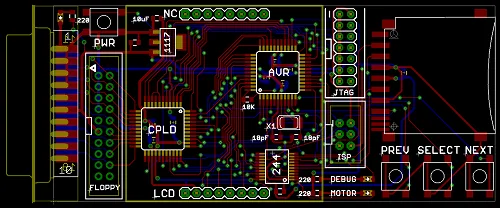
Floppy Emu Board Layout
Whew! It took me a long time to do the board layout for the floppy disk emulator, but here it is! The board is about 4 x 1.75 inches, or roughly the size of an elongated credit card. The resistors,…
Whew! It took me a long time to do the board layout for the floppy disk emulator, but here it is! The board is about 4 x 1.75 inches, or roughly the size of an elongated credit card. The resistors,…
While I’m optimistic that the floppy write emulation technique described yesterday will work (at least for high speed cards), it would be great if I could buy an extra safety margin of time, or find a way of throttling the…
My apologies for another post full of abstract floppy emulation thoughts, with nothing concrete to discuss and no photos to show. As readers have no doubt noticed, I’m having a difficult time wrapping my head around the best way to approach this problem.…
Which would you guess supports faster write speeds: a modern high-speed class 10 SDHC Flash memory card, or a vintage 1984 floppy disk employing a mechanical stepper motor to move its drive head, spinning magnetic media at a lazy 400…
I have floppy disk write emulation almost working for Floppy Emu, using an almost painfully simple technique. When the Mac sends data to be written, an interrupt routine decodes it and stores it in a RAM buffer. Once a full…

I’m working on adding write support for the Floppy Emu emulated Macintosh floppy drive. Data coming from the Macintosh to be written to the floppy is encoded in an interesting way. There’s no clock signal, but just a single WR data…
Page 1 of 13