

Archive for the 'Floppy Emu' Category
A Good Idea That Wasn’t
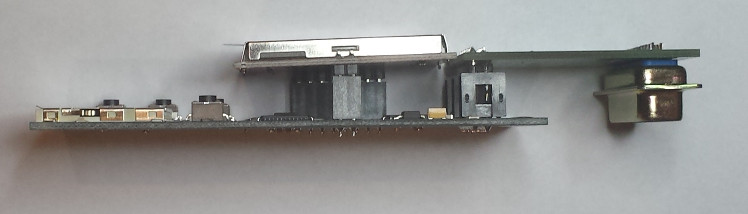
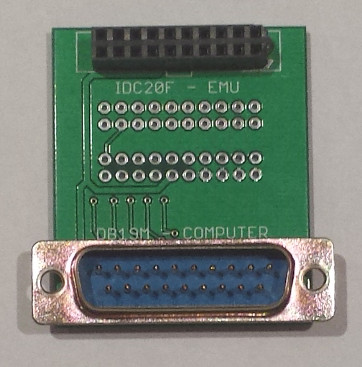
A few weeks ago I designed a right angle adapter PCB for the Floppy Emu. The idea was to make a little board that plugged into a standard Emu and converted it to right angle rear mounting, with the LCD and buttons facing outward, and the main board leaning against the back of the computer’s case. It’s possible to hack your Emu to do this, but I wanted a solution without needing to resolder or modify anything.
Unfortunately the geometry is wrong, and the adapter doesn’t fit. In order to plug into the computer’s floppy port, the DB-19 connector on the adapter board needs to extend about 1 cm behind the main Emu board. But as you can see in the photo, it doesn’t extend behind the main board at all. It’s not even close. So the main board just whacks into the Mac’s case and won’t let the adapter go any further.
I knew the geometry would be a problem even before I sent the adapter boards off to be made. I was hoping there would be enough flex or play in the connections that it would still fit, but no dice. Chalk this one up as a learning exercise!

Bagging the DB-19
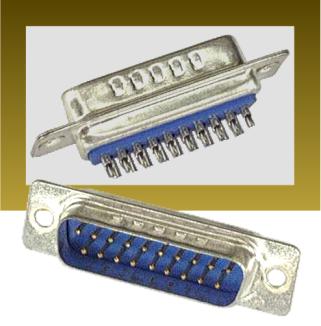
After days of fruitless searching, I finally found a shop in Macedonia with a stock of DB-19 male solder cup connectors. I bought them all! To be honest, I had to check a map to learn where Macedonia is, because it’s not exactly one of the top 10 most likely sources for electronic components. Total cost for 500 pieces including VAT and shipping was 27019 denar, or about $497 US dollars at current exchange rates, so that’s just under $1 per connector. Not bad, considering most other places wanted to charge $2 to $4 per connector, if they even had them in stock.
I may have to pay import duty tax. I’m not sure how that works, but I assume DHL or somebody will tell me what’s needed. The total price also includes about $50 in European VAT, which as a United States buyer I shouldn’t need to pay. Anyone have experience in getting VAT refunded? I presume there’s a form I need to send somewhere.
At almost the same time that I heard from Macedonia, I also got my first concrete response from a supplier in China about manufacturing new DB-19 connectors. We discussed two options: a soft tooling setup, with a lower initial setup fee but higher per-piece cost, or a hard tooling setup with the opposite cost balance. I asked for soft tooling. After many rounds of back and forth, I finally received a setup cost quote of (drum roll…) $11,185. They didn’t state what the per-piece cost would be after setup, but already it’s too expensive. Unless I could somehow band together with other DB-19 users in the Atari and Apple II communities for a large combined order of 10000+ pieces, it’s not practical.
I won’t rest easy until the package from Macedonia arrives. Even though they say they’re sending 500 pieces of DB-19P male solder cup connectors, and the photo on their web site looks right, I’ve found too many vendors whose web sites are out of date, or whose stock mysteriously disappears when you try to place an order. Or maybe they’ve got 500 DB-25 connectors in a mislabeled box, and will be sending those to me. I’m crossing my fingers in hopes that nothing will go wrong.
Floppy Emu demand has been widely variable, so I’m not sure if 500 pieces will be enough supply to last two years or only a few months. The Macedonian shop wasn’t sure if they could get more stock, so at some point I’ll likely run out of DB-19 connectors again. I’ll continue hunting for other sources and refining my DB-19 substitute designs.

Edit: I was just about to post this update, when I noticed the order confirmation page from the Macedonian shop says the order both was and wasn’t successful. So which is it? Ugh. The saga continues…
Read 7 comments and join the conversationDesigning a DB-19 Substitute
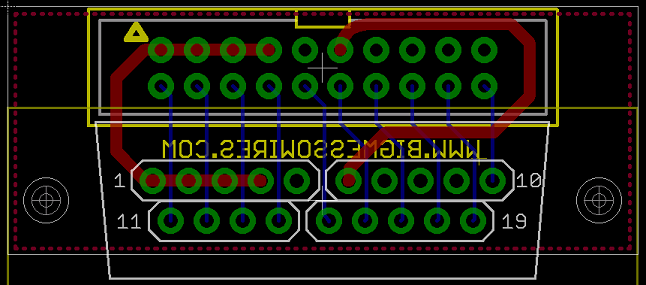
I’m still searching for a source of more DB-19 connectors, but so far I’ve been unsuccessful finding a single one. As a backup plan, I’m exploring building a DB-19 substitute using a PCB and 19 individual pins. The result won’t really be a proper D-SUB connector, because it won’t have a surrounding shield, but it will still fit a DB-19 female port. Add a standard IDC-20 connector to the back side of the same PCB, and it can make a strange but effective DB-19 to IDC-20 converter cable.

The first version of this PCB is shown above, and is based on an idea by Charles Phillips. It uses four sections of standard 0.1 inch (2.54 mm) pitch male header. That’s the wrong pitch – a D-SUB connector has a 2.77 mm pitch – but it’s close enough that short sections of 4 or 5 header pins can bend a little and still fit the D-SUB. The advantage of this version is that it’s cheap and easy to make, and should be no trouble for the board assembly shop. Reliability is a question, though. Slightly bent pins may not make good contact inside the female port, or there may be an issue with square header pins in round port holes. But the initial tests look promising.
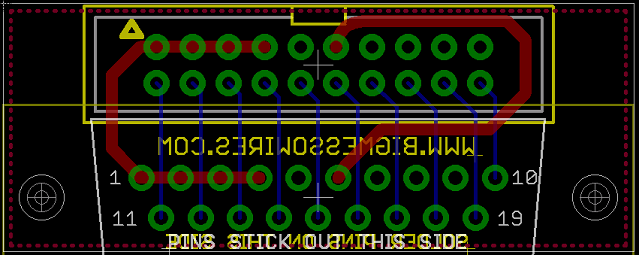
The second version of the PCB is very similar to the first, except the pads are all on a 2.77 mm pitch D-SUB grid instead of a 0.1 inch (2.54 mm) pitch. And instead of using 0.1 inch male header, it uses 19 individual D-SUB crimp pins in a non-standard way: the pins are each soldered in place, and then the crimp sections are cut off. The advantage of this version is that the pin spacing is perfect, and the pins are round, so the fit in the female port should be perfect. But it would be a couple of dollars more expensive, and it’s something that would have to be done manually, without standard assembly tools or processes. I need to check with the board assembly shop I’m using to see what effect it would have.
Neither of these PCBs has a shield surrounding the 19 pins, so if somebody tried hard enough, they could insert the connector aligned incorrectly. With the whole unit offset by 1 pin horizontally or vertically, the connected electronics might get zapped with 12 volts on a signal pin. You’d have to try pretty hard to do this, though.
Read 7 comments and join the conversationFloppy Emu – Back in Stock
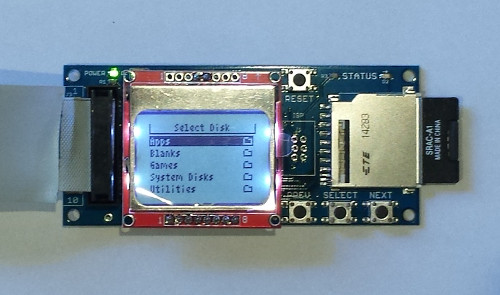
After a long delay, Floppy Emu is back in stock and available for sale now. It’s available with a built-in connector for placement at the rear of the Mac, or bundled with a three foot extension cable so you can place it anywhere on your desk. Beginning with this batch of hardware, the LCD backlight is now enabled by default too. Woot!
I’m having difficulty locating sources for the floppy connector, a DB-19 male D-SUB. These were common in the 80’s and 90’s, but the supply has dried up and they’re almost impossible to obtain now. I’m still chasing down possible sources and investigating alternatives. If I don’t find a good solution, this may be the last batch of Floppy Emu hardware for a while.
As a new option, I’m now offering an SD card preloaded with disk images of System software versions 1 through 7.5.3, as well as some classic software like MacPaint, Hypercard, After Dark, Kid Pix, and Fool’s Errand. Cases for the Floppy Emu are also available, in brown wood hardboard or clear acrylic.
For those who have waited patiently on the waiting list since mid-December, thank you. Happy emulation!
Be the first to comment!In Search of the Elusive DB19
Discontinued parts are bad, “unobtainium” parts are worse. Floppy Emu uses a 19-pin D-SUB male solder cup connector, otherwise known as DB19P, to connect to the computer’s floppy port. DB19 connectors were never common, and were only used in 1980s and 1990s Macintosh, Atari, and some NeXT computers. Today in 2015 they’re very difficult to find. As far as I can tell they’re no longer manufactured, and are only available in small quantities from electronics surplus warehouses.
My hardware sales appear to be drawing down the remaining worldwide stock of these connectors. Working with the vendor who assembles the Floppy Emu boards, we’ve purchased the entire remaining stock from three surplus warehouses, and been advised that they won’t be getting any more. We have enough to finish the current batch of 100 boards, but after that it’s not clear if we can find more DB19s at a reasonable price, or at any price. Worst case, this will be the last batch of Floppy Emus, and I’ll have to stop selling them when the supply runs out. And a couple of DB19-based adapter boards I was planning to release will never see the light of day.
Vendors
Searching the web, it seems there are at least half a dozen places that sell DB19 male solder cup connectors. But if you look carefully, several of them are just alternate storefronts for the same company with the same stock. A few places show DB19 but list it as out of stock. At least one other shows it as in stock, but if you call them you’ll learn it’s actually not available.
These are the same vendor. I’ve bought their entire stock. They won’t be getting more.
These are the same vendor. Out of stock, not clear if they’ll be getting more.
Elliott Electronics Supply
Network Cables
These look like active vendors. I haven’t called yet to confirm availability or quantity in stock.
There’s one more vendor I won’t list here, because I don’t want other people buying up their stock. They’re kind of a pain to work with, but I’ve used their parts for all my boards thus far. Now they’re out of stock, and it’s not clear if they’ll be getting more, or if this is the end. Their web site says they are newly-manufactured parts, so I’m hopeful.
Options
A couple of other options, if the supply of DB19 connectors disappears:
- Use DB25 connectors, and cut off 6 pins. This might or might not fit, depending on the mounting screws and case cutout surround the DB19 port on each Macintosh model. It might be necessary to cut away part of the metal housing of the connector, using tin snips or a Dremel. It would be a lot of extra work, look ugly, and require a modification to the Emu’s PCB.
- Find an Asian manufacturer to make DB19 connectors. If I commit to buying enough of them, I bet I can find a D-SUB manufacturer in Asia who’d be willing to set up tooling machinery to build DB19s. I’m not sure how many I’d need to buy, though – thousands? And I’m not sure how to find potential Asian partners, and make a proposal to them. My first thought is to use Alibaba to identify existing D-SUB manufacturers of other sizes.
Board Assembly Headaches
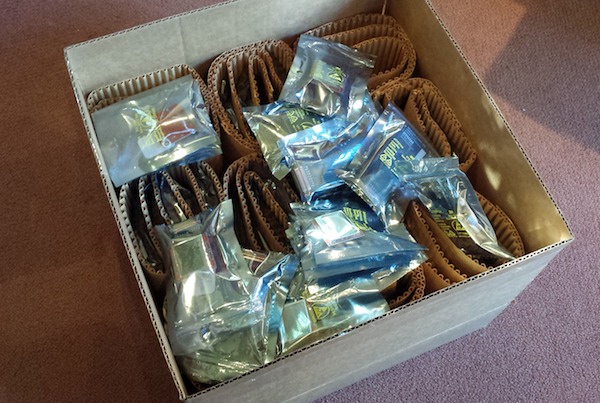
This is what 100 unsaleable Floppy Emus look like. After six weeks of waiting, today I received the new batch of assembled boards, and eagerly opened the box. Excitement gave way to dismay when I discovered that every one of them was assembled incorrectly. Arghh, noooooo! I’ve been unable to fill any orders since mid-December, so I’d been counting down the days until the new hardware was expected to arrive. Now it looks as if there will be a further delay of about a week. Manufacturing is hard.
For whatever it’s worth, my instructions were correct and the error was the fault of the assembly shop. That means I won’t have to pay to fix the mistake, but it doesn’t help me get corrected boards any faster.
The assemblers transposed a part from the extension cable’s IDC20 to DB-19 adapter onto the main Floppy Emu board itself, and also omitted one component. The resulting boards still work, but won’t fit the Floppy Emu cases, and I’m left without any usable extension cables. After some discussion on how to make things right, I agreed to return the whole batch to the assembler, and they’re going to rework the boards to the correct design. I’m not certain how long that will take, but I expect it should be finished by next week.
I could demand that they replace the entire batch with new parts, or give me the batch for free, but I don’t think that would go well. Like me, they’re a small business, and I don’t want to stiff them for thousands of dollars in losses if they can make good on their mistake through rework. And quite frankly I’m lucky they accept my business at all, since my order sizes are so small compared to their typical jobs. If I stomp my foot and demand a pound of flesh, I may get it, but I may also be asked to bring my future business elsewhere. I like working with this shop – they’re reasonably priced and local – and I’d hate to start over from scratch building a relationship with a new assembler in some far-off location. So for now I’ll wait, impatiently.
Read 16 comments and join the conversation